Providing you’re well wrapped up, Rome is a delightful destination in winter. Of course there are always a few shivering ill-informed tourists who believe that Italy is always sunny and hot. They walk around in shorts looking miserable, probably wondering why they came, but there’s so much to see in winter, and it’s great without the crowds. Museums are almost empty; the ruins take on a mysterious air in the grey skies and even the Metro isn’t quite as packed as usual.
When I was at the Ara Pacis last week, there were only three other people there. But what exactly is the Ara Pacis? It’s an enormous stone altar built 2,000 years ago by Emperor Augustus, a miracle of survival and painstaking restoration.
It’s rather ironic that its name, which translates as ‘altar of peace’ was used for sacrifice. It was originally positioned so that an obelisk would cast a shadow through it on Augustus’ birthday, but it was eventually moved to its present site following excavations under Mussolini who saw it as a monument to Roman glory.
Over the centuries, the altar was buried following floods when the Tiber burst its banks, and many carved fragments disappeared. Eventually, in 2006, the whole piece was moved to its present site and the architect Richard Meier designed a superb glass enclosure for it to be protected from future damage.
It’s amazing to think that at the time building work began on this altar in 13BC, the population of Rome was already 1 million and the city was full of great monuments while the rest of the known world outside the empire was still living in primitive conditions with no monuments for hundreds of forgotten generations.
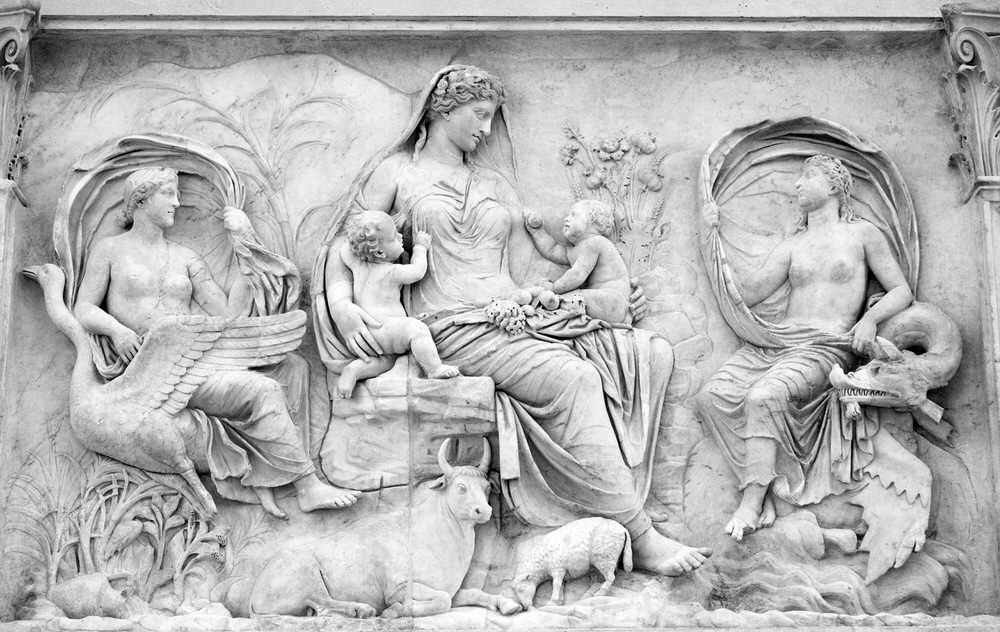
The stone reliefs represent mythological scenes and include the wolf and twins Romulus and Remus, the ‘founders’ of the city of Rome. Fragments were collected from all over the city. Where pieces are missing there are outlines to show the continuation of the decorations so that from a distance it appears perfect, almost newly built.
For visitors there is a film in Italian (and English if you press a button) explaining its history and offering a welcome 10 minutes to sit down for the footsore tourist!
Beneath the glass museum there is an exhibition space, currently with a superb show of Impressionist paintings from the Detroit Institute of Art.
Incidentally, if you’d like to find an authentic trattoria nearby when you’re in need of a meal after all that high culture, I recommend Fiaschetteria at 39 Via della Croce. Usefully, it’s open continually from lunchtime until late evening, so if you are so absorbed by the glories of Rome that lunchtime has been and gone, it will still be open!