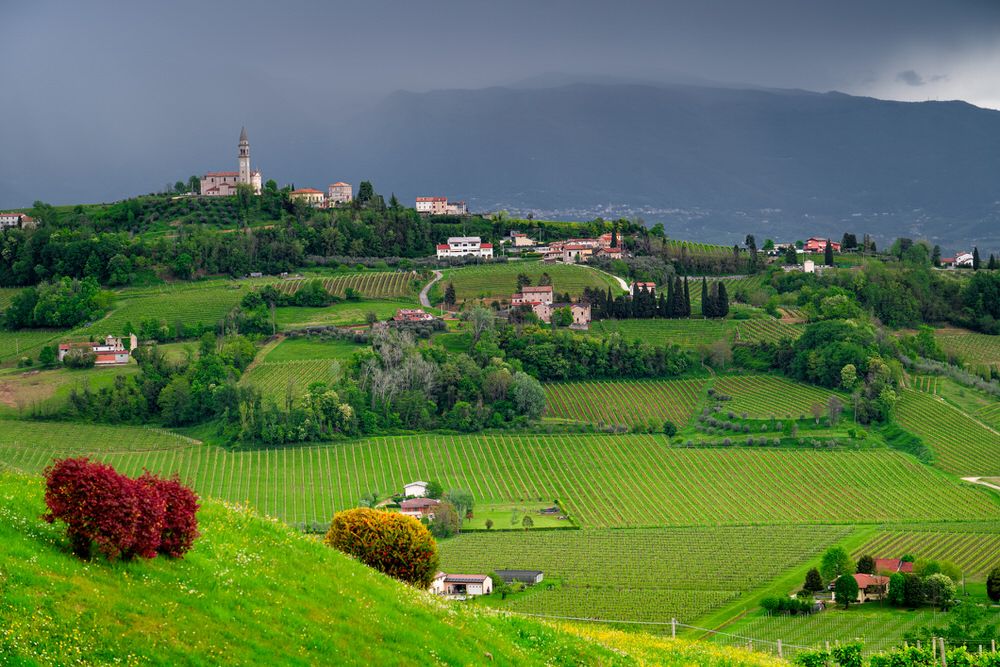
Stretching from the snowcapped peaks of the Dolomites to the calm waters of the Adriatic Sea, Veneto is one of Italy’s most diverse and historically rich regions. Located in the country’s northeast, Veneto is a place of striking contrasts with mountains and lagoons, medieval hill towns and modern industry, global tourism and deeply rooted local traditions.
Veneto’s geography tells much of its story. To the north rise the Dolomites, a UNESCO World Heritage site and home to alpine communities such as Cortina d’Ampezzo. Moving south, the land opens into fertile plains carved by the Adige, Brenta, and Piave rivers, before reaching the Venetian Lagoon and the Adriatic coast.
This variety has made Veneto a crossroads for centuries – open to trade, migration, and cultural exchange, while also shaped by the natural boundaries of mountains and sea.
At the heart of the region lies Venice, one of the world’s most recognizable cities. For over a millennium, the Republic of Venice was a dominant maritime power, controlling trade routes across the Mediterranean and influencing politics, art, and commerce far beyond Italy.
That legacy still defines Veneto. Venetian architecture, civic institutions, and artistic traditions extend well beyond the lagoon, visible in cities such as Verona, Padua, and Vicenza. The region’s wealth of Renaissance art and Palladian villas reflects a period when Venice’s influence shaped much of Europe.
Veneto’s cities each carry a distinct identity. Venice is a living museum, balancing mass tourism with the daily life of its residents. Verona, famed for its Roman arena and Shakespearean associations, remains a vibrant cultural center. Padua is home to one of Europe’s oldest universities and a long tradition of scientific thought. Vicenza showcases the architectural legacy of Andrea Palladio, whose designs influenced buildings worldwide.
Together, these cities illustrate Veneto’s ability to preserve history while remaining economically and culturally dynamic.
Veneto is one of Italy’s economic engines. Its economy blends manufacturing, small family-run enterprises, agriculture, and tourism. The region is known for high-quality craftsmanship, from eyewear in Belluno to luxury fashion, furniture, and machinery produced across its industrial districts.
Agriculture remains central as well. Veneto is a global leader in wine production, particularly Prosecco, Amarone, and Soave. Local food traditions like risotto, polenta, seafood, and cured meats reflect both the region’s land-based and maritime heritage.
Veneto has a strong regional identity. The Venetian language, spoken alongside Italian, is widely used in daily life and carries a sense of local pride. In the northern areas, Ladin culture adds another layer to the region’s linguistic and cultural landscape.
This sense of identity has at times translated into political movements advocating for greater regional autonomy, reflecting Veneto’s long history of self-governance dating back to the Venetian Republic.
Like much of Italy, Veneto faces challenges: managing overtourism in Venice, balancing economic growth with environmental protection, and adapting to climate change, particularly rising sea levels in the lagoon and changing conditions in the Alps.
At the same time, events such as the 2026 Winter Olympics in Cortina d’Ampezzo have placed renewed international attention on the region, highlighting both its global appeal and the need for sustainable development.
Veneto is not defined by a single image. It is at once alpine and maritime, ancient and industrial, local and global. From gondolas and grand palaces to vineyards and mountain trails, Veneto embodies the layered complexity of Italy itself.
In Veneto, history is not something sealed behind glass. It remains woven into daily life, shaping how the region moves forward while staying deeply connected to its past.