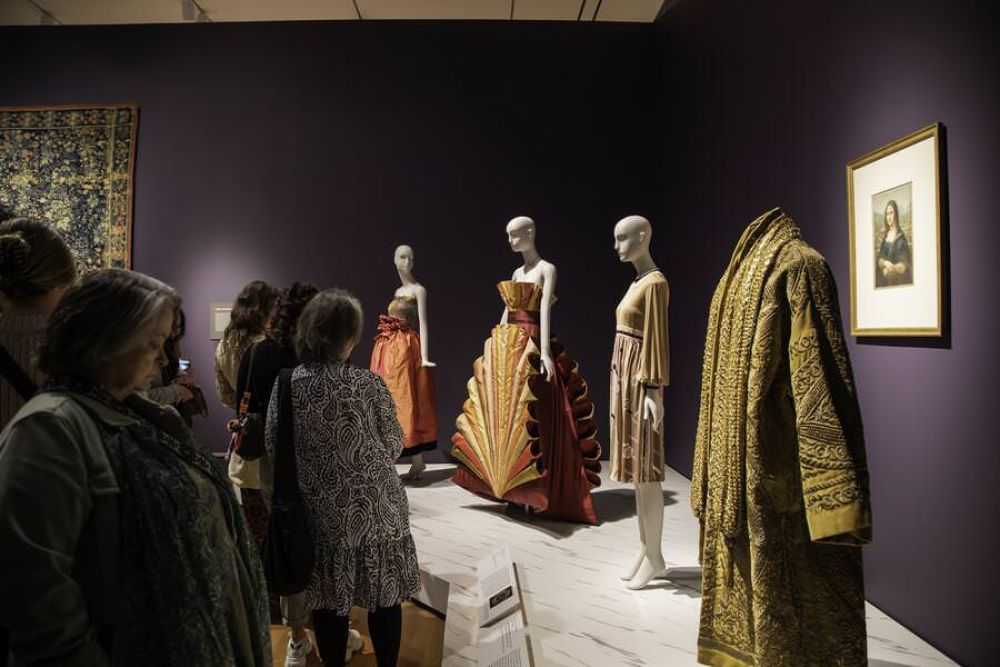
“Renaissance to Runway: The Enduring Italian Houses”
Through Sunday, February 1, 2026
The Kelvin and Eleanor Smith Foundation Exhibition Hall
Fashion as a medium undeniably addresses ideas that transcend time from the past into the present. Through the majestic creations of more than 100 modern and contemporary Italian fashions and accessories in dialogue with Italian fine, decorative, and textile arts from the 1400s to the early 1600s, “Renaissance to Runway: The Enduring Italian Houses” examines the art historical inspirations that fuel recent creative Italian lexicon, expanding fantasies of the Renaissance, Mannerist, and early Baroque periods.
More than 500 years ago, families, or “houses,” who ruled the states across the Italian peninsula, such as the Medici of Florence and the Sforza of Milan, used fashion as a form of power and influence, from dictating fashionable styles that were immortalized through painted portraits to controlling textile production as a form of currency. Conversely, since the turn of the 1900s, rising Italian fashion companies, also called “houses,” have been founded by prolific individuals and families who dominate global style with unmatched design craftsmanship, quality fabrics, and enthralling aesthetics. From Versace and Valentino to Ferragamo and Capucci, these houses have interpreted Italian early modern–period aesthetics to develop fresh perspectives throughout the fashion landscape. This exhibition illustrates how fashion, in all of its change, is a continuous thread that uncovers history’s complexities as it materializes contemporary beauty.
“Filippino Lippi and Rome”
Through Sunday, February 22, 2026
Julia and Larry Pollock Focus Gallery, Gallery 010
In the century following his death, Florentine painter Filippino Lippi (c. 1457–1504) was celebrated as “a painter of the most beautiful intelligence and the most lovely invention.” After training with his father—the luminary artist Fra Filippo Lippi—Filippino Lippi apprenticed and collaborated with Sandro Botticelli, in whose workshop he developed his own style. Filippino found great success as an independent painter in late quattrocento Florence and won the favor of patrician families as well as the patronage of Lorenzo “The Magnificent” de’ Medici, the city’s de facto ruler. Upon Lorenzo’s recommendation, Neapolitan cardinal Oliviero Carafa engaged Filippino to decorate his sizable chapel in Rome’s Santa Maria sopra Minerva. The resulting frescoes, painted between 1488 and 1493, are among the most celebrated of the Renaissance. Filippino found new inspiration in the fragments of ancient paintings, sculpture, and architecture across the Eternal City; the painter’s designs for the Carafa Chapel demonstrate a shift in both his style and iconography. After returning to Florence, Filippino continued to incorporate his Roman innovations in his paintings for the remainder of his life.
“Filippino Lippi and Rome” reconsiders the lasting impact of the painter’s time in the Eternal City, juxtaposing Filippino’s Roman artworks with their Florentine precursors and successors. The exhibition places 25 paintings, drawings, and antiquities in direct conversation with important loans from national and international lenders, including the Metropolitan Museum of Art; His Majesty King Charles III; the National Gallery, London; the Galleria degli Uffizi; and the Gemäldegalerie, Berlin, among others. For the first time, these related artworks are brought together, in some cases reuniting paintings with their studies. Each object has been carefully selected to elucidate the evolution of Filippino’s artistic practice before, during, and after his Roman period. The Cleveland Museum of Art’s seminal tondo by Filippino, “The Holy Family with Saint John the Baptist and Saint Margaret”, is at the center of the exhibition. Commissioned by Carafa while Filippino was frescoing the cardinal’s chapel, this important painting is the only known independent work produced by the artist in Rome. “Filippino Lippi and Rome” traces the arc of Filippino’s career across time and media, constituting a unique opportunity for scholars and the public alike to discover the artistic processes and iconographic ingenuities of one of the most gifted and accomplished Renaissance painters.