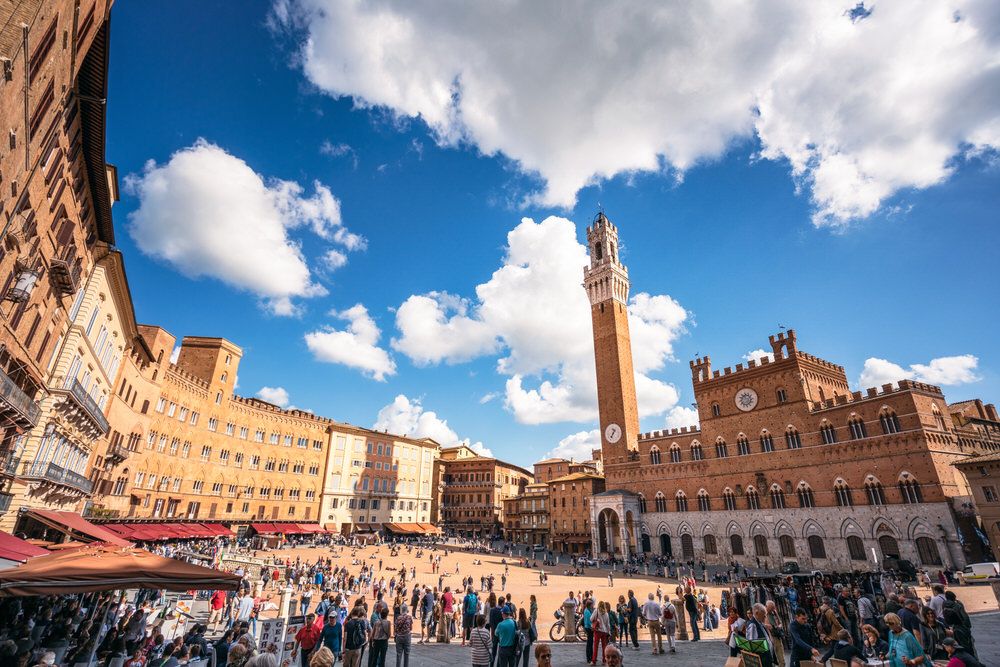
There are few experiences in life as effortlessly rich and pleasurable as spending time in an Italian piazza. More than just a town square, the piazza is the beating heart of Italian social life – a stage where everyday life unfolds in full color, from the slow clink of espresso cups to the spontaneous eruptions of laughter, protest, music, or flirtation.
Whether in Rome, Florence, or a small hilltop village in Tuscany, the piazza holds a sacred space in Italian culture. It's not just a place you pass through. It's a place you stay. And staying is the point.
Hanging out in a piazza teaches you the Italian art of il dolce far niente – the sweetness of doing nothing. Italians, masters of this philosophy, turn the piazza into a theater of leisure. Locals lean into conversation at shaded café tables, children chase pigeons around centuries-old fountains, and couples stroll arm in arm beneath pastel buildings that seem to glow in the evening light.
To be in a piazza is to slow down. There's no rush. The rhythm is unhurried, and the joy is in the moment. A sip of aperol spritz, a lick of melting gelato, a sudden street performance, a friend calling your name from across the square.
Nearly every piazza in Italy is soaked in history. In Venice, Piazza San Marco opens wide to the lagoon, framed by the grandeur of St. Mark’s Basilica. In Siena, the scallop-shaped Piazza del Campo has hosted medieval horse races for centuries. Even in small towns, piazzas are often flanked by Roman ruins, Renaissance churches, or Baroque fountains. Sitting on a stone bench, you’re not just watching the present unfold—you’re surrounded by echoes of the past.
Italians treat the piazza like an extension of their home. It’s the communal living room where friends meet, news is exchanged, and life is shared. There’s little distinction between public and private. You’ll see locals in animated debate, teenagers flirting with awkward confidence, elders playing cards, and waiters who somehow remember every order and name.
Unlike many modern city squares that feel overly manicured or commercial, Italian piazzas remain wonderfully unpolished, alive with the imperfections and unpredictability of real life.
The piazza evolves with the day. In the early morning, it’s the domain of delivery men, dog walkers, and early risers sipping cappuccino. By late morning, the café tables fill with locals and tourists alike. Afternoons might be sleepier, especially in summer heat, but the evenings are the piazza’s true golden hour. The air cools, the lights warm, and the entire town seems to pour into the square. Laughter, clinking glasses, live music – it’s all there. Even at midnight, the piazza doesn’t sleep. Somewhere, someone is still talking, still living.
You don’t need a plan to enjoy a piazza. In fact, it’s better if you don’t have one. Just find a seat, on a bench, a fountain edge, or a café terrace, and let the life of the square wash over you. Read a book. People-watch. Order another espresso. Listen to the dialects blending around you. Let time stretch. Because in the piazza, time isn't something to be managed. It's something to be tasted.
To hang out in an Italian piazza is to participate in something timeless and deeply human. It’s a ritual of connection – not only to others but to place, history, and self. In a world that often values speed, productivity, and noise, the piazza offers an alternative: a celebration of presence.
So next time you find yourself in Italy, skip the tourist checklist for a while. Find a piazza. Sit down. Order something. And stay a while. You'll never see "nothing" quite the same way again.