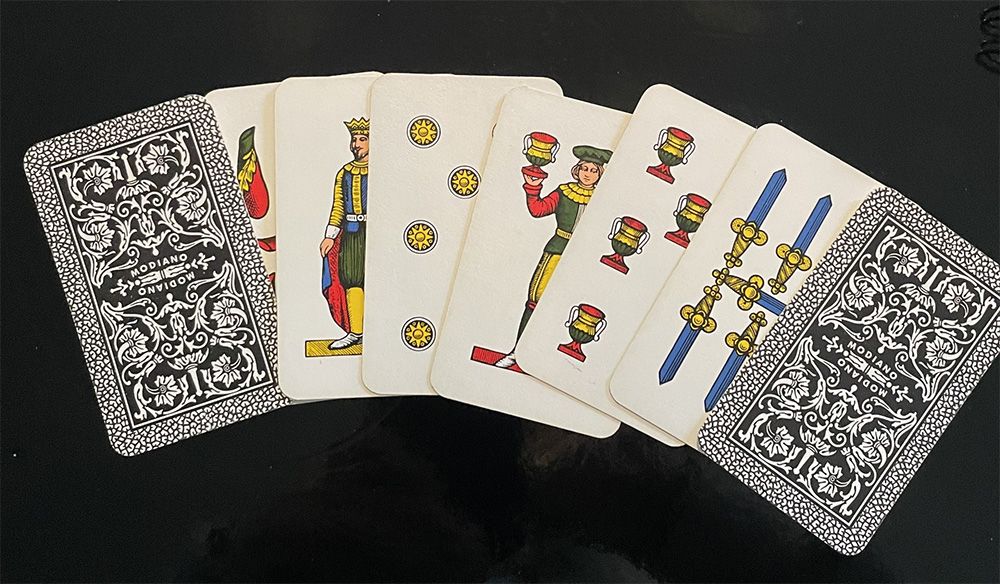
Questo articolo descrive il gioco della "Scopa", che è giocato con carte italiane. Scopa significa "bastone che spazza", perché l'obiettivo del gioco è di spazzare via tutte le carte sul tavolo. L'articolo descrive le regole e come vincere. Anche se il gioco sembri semplice e facile, la Scopa richiede strategia e anche un po' di fortuna. Dina Vitantonio, che lavora per il Piccola Italia Block Club, organizza le gare di questo gioco. Questo è il secondo anno e ci sono sedici squadre. Si gioca una volta al mese da settembre a fine aprile. Per maggiori informazioni, chiama il numero in fondo all'articolo.
Scopa is a traditional Italian card game that is over 40-years-old. Scopa, meaning “broom” or “sweep,” refers to the act of sweeping all the cards on the table in a single match play. Some believe it evolved from Spanish card games common in ports during the 15th century. It was thought to have been brought to the ports of Naples and Genoa by pirates and fishermen in the late 1700s. By the 19th century, it was the most popular game in piazzas and bars in Italy. It then spread to other countries through Italian emigrants, particularly to South America. Eventually, it became popular in Italian American communities across the country.
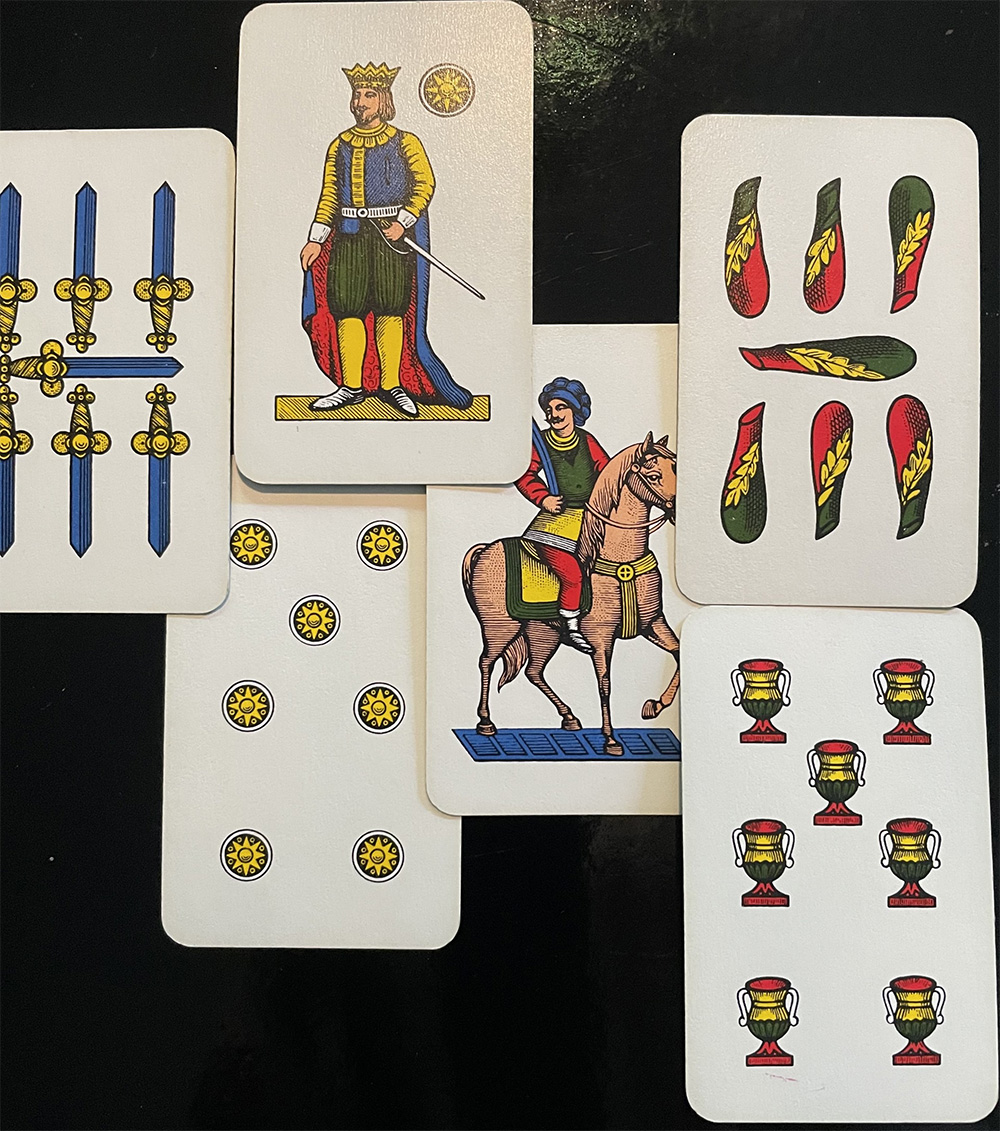
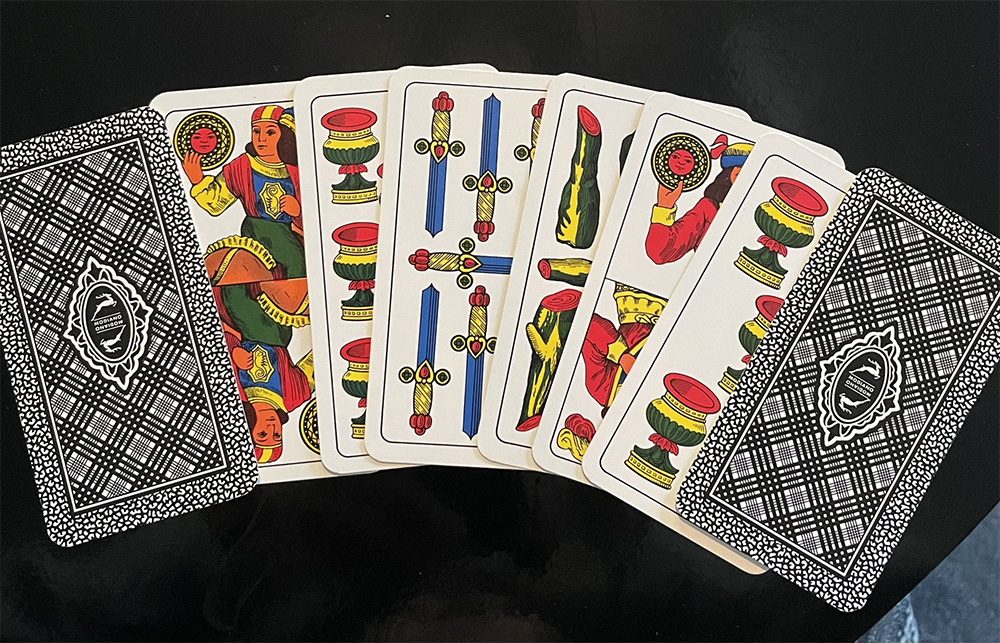
Scopa is played with a 40-card deck of four suits: denari (coins), coppe (cups), spade (swords), and bastoni (clubs), in denominations of one through seven. There are three “face” cards: Fante (Knave or Jack) worth 8 points, Cavallo (Cavalier or Knight) worth 9 points, and the Re (King) worth 10 points. There are regional-style decks that symbolize the local culture through distinct artwork and suit designs. The most popular are the Napoletane/Neapolitan from Naples and much of the South, the Siciliane from Sicily, and the Piacentine from Northern and Central Italy.
This card game is typically played between two people or four players in pairs, with each pair pooling their points at the end of each match. Although it may seem easy to learn once you get used to the card designs, it can be difficult to earn points. A combination of strategy and luck, along with a knack for remembering what cards have been played, and you have a good chance of beating your opponent.
The dealer deals in a counterclockwise fashion, three cards face down to each player, and places four cards face up in the center. The object is to capture a card, or a combination of cards on the table, with a matching value from your hand. Your goal is to collect as many sevens (especially the seven of coins), as many coins, and as many cards as possible, and of course, making a “scopa” sweep whenever you are able.
Scoring is as follows, with one point for each of these: most cards captured through matching, most denari (coins), the settebello (the 7 of coins), each “scopa” sweep, and the primiera (the highest value set of four cards, one of each suit). Scoring for the winner of the primiera is as follows: the 7 card is worth 21 points; the 6 is 18 points; the Ace is 16; the 5 is 15; the 4 is 14; the 3 is 13; and the 2 is 12. Whomever is first to reach 11 or 16 points (decided at the start of play) is the winner.
I have been playing this card game since I was young, always on the lookout for someone to play with. When I found out that Dina Vitantonio, chairperson of the Little Italy Block Club, a group that is involved in community engagement, started a Scopa group at the Alta House, I was excited to join. Starting in September 2024, she had gathered nearly 100 people comprising a 12-team roster of players, including substitutes. This was the first season of competition ending in May 2025, with an awards banquet for the team with the most points in each category of play.
For the second season, which commenced in September 2025, there are now 16 teams of four players and two substitutes who meet on the second Tuesday of the month from September through April at Little Italy’s Alta House.
Dina would love to have inter-league play someday and possibly host the Italian Tombola (our Bingo), typically played during the Christmas and New Year’s holidays.
Anyone interested in joining Scopa or any other community events on the LIBC calendar may contact Dina Vitantonio via text at 347-326-3766.
https://www.lagazzettaitaliana.com/history-culture/10713-scopa#sigProId45becd94a8