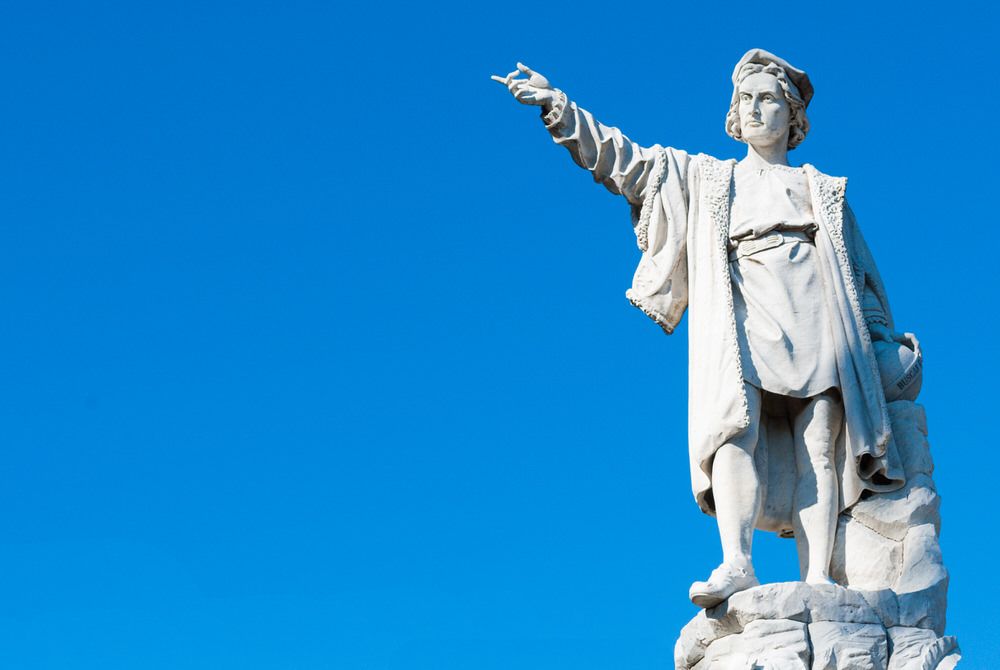
Christopher Columbus, Cristoforo Colombo in Italian, remains one of history’s most famous navigators, credited with opening the way for European exploration of the Americas after his 1492 voyage. Born in 1451 in the Republic of Genoa, a maritime powerhouse in what is now northwestern Italy, Columbus has long been a figure of both national pride for Italians and heated debate worldwide.
Though he sailed under the Spanish crown, Columbus was deeply shaped by the seafaring culture of Genoa. Growing up in a port city, he gained experience in navigation, cartography, and trade. Italians, especially Genoese citizens, have historically claimed him as one of their most significant contributions to world history. Genoa hosts the Cristoforo Colombo Monument and preserves archival records of his life.
Italian immigrants to the United States, especially in the late 19th and early 20th centuries, adopted Columbus as a cultural symbol, linking his adventurous spirit to their own journeys abroad.
In the U.S., Columbus Day became a federal holiday in 1937, largely through lobbying by Italian American organizations. For decades, the celebration served as a point of pride and visibility for the Italian community, often featuring parades, cultural events, and tributes to Italy’s heritage.
In Italy itself, October 12 (Giornata Nazionale di Cristoforo Colombo) is marked more modestly, often with historical exhibitions, school lessons, and maritime commemorations.
In recent years, Columbus’s legacy has been reassessed, especially in the Americas, where critics highlight the devastating impacts of European colonization on Indigenous peoples – violence, disease, and exploitation. This has led to statue removals in several U.S. cities, replacing Columbus Day with Indigenous Peoples’ Day in some regions, and a growing conversation in Italy about balancing historical pride with acknowledgment of colonial consequences.
While Italians still recognize Columbus as a key figure of the Renaissance age of exploration, modern discussions tend to focus on historical complexity rather than uncritical celebration. Genoa and other cities promote a nuanced view, emphasizing the maritime history, scientific advancements in navigation, and cultural exchanges that followed, while acknowledging the darker chapters of European expansion.
Today, Columbus Day celebrations are making a resurgence in many U.S. cities. Both The Italian American community in South Philly united to not only restore the holiday but also bring back the Columbus statue. This marked a notable shift in the city’s recognition of Columbus Day. Dating back to the late 19th century, Italian Americans in South Philadelphia celebrated Columbus Day by marching to the Columbus statue at Marconi Plaza, a tradition anchored by the statue erected in 1876. This tradition appears to be reemerging as community enthusiasm has reignited.
The Columbus Day Parade in Cleveland is one of the city's oldest cultural traditions. The Cleveland Columbus Day Parade will step off at noon on Monday, October 13, along Mayfield Road in Little Italy, continuing a beloved tradition that celebrates Italian American pride and community. Basil Russo, a prominent voice in local and national Italian American advocacy, has been instrumental in preserving the event as a lasting symbol of heritage and cultural identity.
The parade will feature thousands of participants and attendees, elaborate floats, vintage cars, the famed Orlando bread truck, marching bands, local vendors, plus a variety of authentic Italian and Italian American fare along Mayfield and Murray Hill roads.
Cleveland’s Columbus Day celebrations, sponsored by Italian Sons and Daughters of America (ISDA), date back to 1920 when several Italian American enclaves across the city paid homage to their heritage. After World War II, the parade unified and was held downtown before eventually moving to Little Italy in 2004.
For Italians, Christopher Columbus occupies a unique space – part national hero, part global historical figure, and part subject of controversy. Whether celebrated for his daring voyages or examined through the lens of their consequences, Columbus remains an enduring, if complex, symbol of Italy’s role in shaping world history.