Before smartphones and translation apps, a phrase book and disposable cameras taught me everything I needed to know about being somewhere.
”You’re the last people to travel from Rome to L’Aquila by train in the 20th century,” my cousin Giannino announced with a grin. “You’ll be famous.” With smiles as big as their hearts, he and three great-uncles stood outside L’Aquila’s modest railway station. They pulled us close, delivering massive hugs and kisses on each side of our cheeks.
It was June 1999. The summer after my freshman year in college and seven years since my first trip to Italy. Backpacking Europe was the thrill of my young adult life. But that return to Poggio di Roio in Abruzzo changed everything.
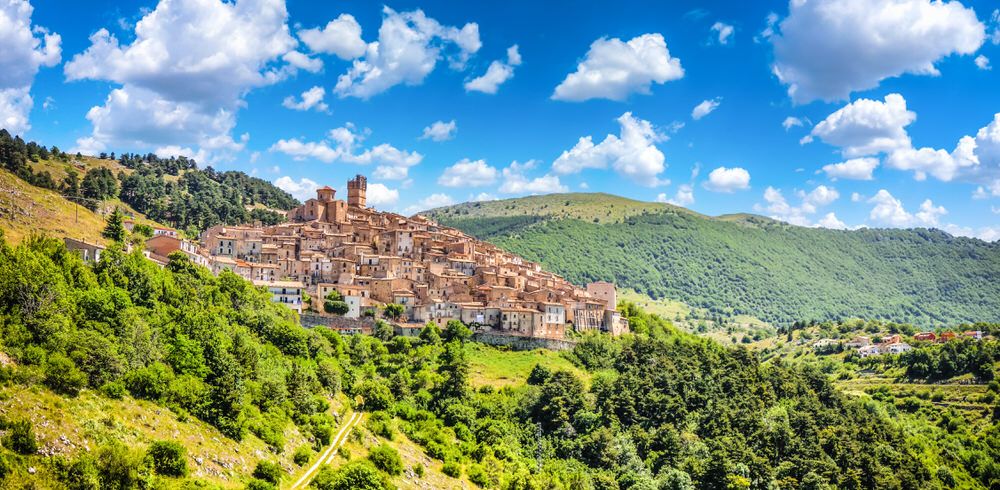
If Italian families have a reputation for warmth, my relatives skew the national average. An entourage surrounded our every step. The tiny village that had once been my grandfather’s home bubbled up with activity.
Twenty-five relatives squeezed into every corner of their dining rooms, rotating across the rustic cucine of our four great-aunts. Steaming bowls of pasta, freshly prepared from flour and eggs, brilliantly green salads from their gardens, homemade pizze, frittate, wine, grappa.
ours and hours trying to be understood. While I can’t be certain, I estimate we said bene, tutto bene no fewer than 1,000 times. Meandering twists, turns, and narrow bends through a village that seemed older than time, where every house perched as organically as the landscape, had a story to tell, or someone’s nonna appeared at the door pouring a moka pot into tiny cups and insisting we stay for espresso.
Not one moment was posted on Instagram. There were no cell phones. Just raw cultural immersion and a few disposable cameras. Twenty-four shots per roll. Ten cameras for the whole trip. They forced a different kind of attention. I had to choose. More importantly, there was no screen to retreat into when conversation became difficult or uncertainty crept in.
When I was thrown into Italian life with no safety net, I had no choice but to engage. I listened harder. I watched more carefully. I learned every scrap of language I could. Out of that trip came a promise: I would learn Italian and return. Two years later, I did.
Today’s travelers have extraordinary tools at their disposal. But convenience can come with a cost. Some of the most meaningful moments of travel happen when you don’t immediately know what to do, where to go, or what someone just said. Discomfort isn’t the enemy of connection. Often, it’s the doorway to it.
On my upcoming trip to Italy, I have no plans to jettison my smartphone. But it will know its place: emergencies and essential communication. I’ll watch Italian TV even when I don’t catch every word. I’ll wander and discover hidden trattorie on my own, regardless of what an influencer might recommend. The tourist current will flow in one direction. I’ll be happy to drift away from it now and then.
You don’t need to visit an Italian family. Italy is generous with visitors who approach it meaningfully and connect. Choose your shots as if you only have 24. Use the phrase book first, the translation app as a last resort. Leave one afternoon with no plan and no map and see what’s around the corner.
If you commit to being present, that analog Italy still exists. Long lunches and unexpected festivals will find you. The barista will learn your order, then your name. Strangers may become friends over a shared confusion about the train schedule — or why it makes no sense to endure a dozen deafening tunnels on the train from Rome to L’Aquila when there is a perfectly good bus that takes half the time.
But it’s a lot harder to find when you’re looking at a screen.
Travel Italy like it’s 1999 and see how it changes you.
Patrick Tunno, PhD, is a professor at Penn State University and the author of “A Guide to Italy: Cultural Insights and Tips to Maximize Your Trip,” a Silver Award winner in Reader Views’ Travel category. He has led study abroad programs throughout Italy and is completing a memoir about his Italian American family’s roots in Abruzzo. patricktunnophd.com.